How to Play RippleEffect
Conversation Starter Game From the Memories that Matter
Finding the right time to share an untold story is hard... but not anymore.
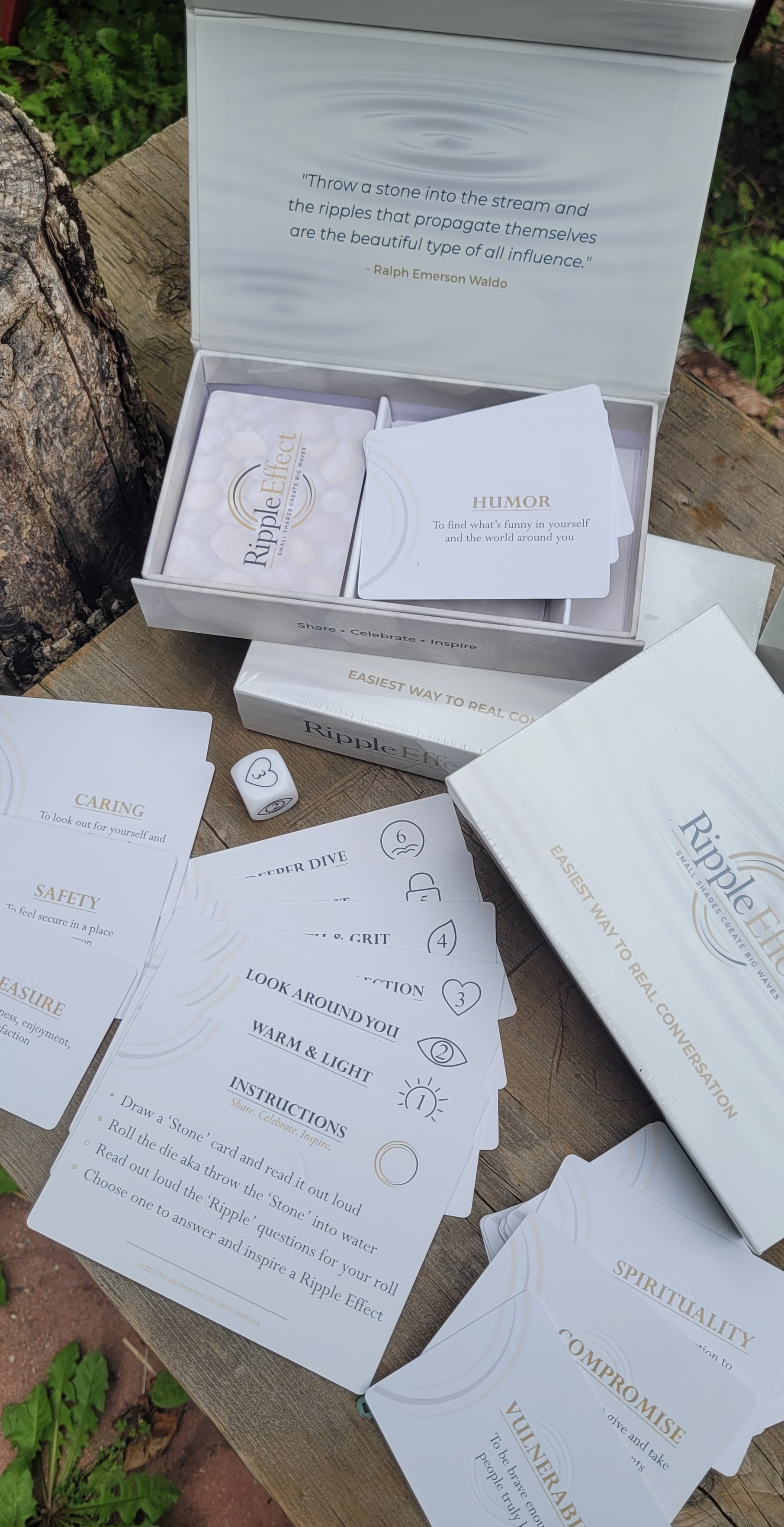
1) DRAW
Draw a Stone Card (a value) from the deck of 60.
2) ROLL
Roll the die to find your Ripple Card, from 1-6.
3) PICK
Every Ripple Card has 3 potential questions. Choose the one that resonates most with a memory or experience tied to your Stone Card.
4) SHARE
Share the story behind your Stone Card and chosen question.
There are no time limits, wrong answers or keeping score. Just a conversation starter game where every share sends a ripple through the group... sparking new memories, new stories, and new connections.
With over 1,000 possible question combinations to inspire your story, everybody wins when no two playthroughs are ever the same.
Tips & Tricks
Great For New Players: Use variations Easy Draw and Keep It Light to ensure their first share is an easy one
There's No Wrong Answer: There's no scoring or performance involved. The point is the story, not landing on a "correct" response, so don't overthink your pick.
Powerful Group Shares: During a player's turn, they read their Stone Card and three Ripple questions out loud, inspiring every player to think of their own related stories, even though it's not their turn. After the roller's share, other players can share their own story that was also inspired by the roller's share.
Frequently Asked Questions
How do you play RippleEffectTM?
Draw a value card, roll the die, and answer the question it reveals — low roll for a light share, high roll for something real. With 1,000+ possible questions across 60 cards, it plays differently every time.
What kind of questions are in the game?
Every question is tied to a value — Gratitude, Family, Mastery, and dozens more — instead of being a random icebreaker. Each one is built to surface something true about how you see yourself, others, or the world.
Who is RippleEffectTM for?
Friends, families, couples, hosts, educators, and facilitators — basically anyone who wants a conversation game that goes past small talk. The die-roll depth means a first hangout and a decade-long friendship can play the same deck and land in very different, equally good places.
What variations does the game have?
To learn more about all our game variations, see the How To Play page.
Classic — Draw a Stone card, roll, pick your Ripple question, share.
Two-Card — Draw two Stone cards, pick the one that resonates, then roll.
Dinner Party mode — A card under each plate, shared over the meal.
Celebration mode — Everyone draws for the guest of honor, and tells a story of how they lived that value.
Is RippleEffectTM a good dinner table question game?
Yes — it's one of the most common ways people play it. The Dinner Party variation is where a card gets placed under each plate, and guests share theirs sometime during the meal, so dinner table questions become part of the meal instead of an activity you have to stop and start.
What ages is it appropriate for?
13 and up. The tiered depth means teens, adults, and mixed-age families can all play the same deck without anyone being pushed into a question they're not ready for.
Is there a wrong way to answer in RippleEffectTM?
No. Keep it light, go deep, tell a quick story — there's no scoring and no performance involved. The point is the story, not the “right” answer.
How does RippleEffectTM compare to Table Topics?
Table Topics gives you a flat list — every question carries the same weight. RippleEffect's die-driven depth means one game can move from icebreaker to genuinely moving, with the group controlling how far it goes. It also has dedicated modes — dinner party, celebration — that function more like a toast alternative than a straight conversation card game.
RippleEffect works backwards from every other conversation game — like Jeopardy, you get your answer first. Draw your Value, roll for depth, then pick which of three questions to answer. That order takes away the blank-stare pressure of being asked a question cold, the way games like Table Topics can feel like a pop quiz.
What makes RippleEffectTM different from other conversation starter games?
Most conversation starter games hand you a fixed list of questions. RippleEffect uses a die to set the depth first, so you're never guessing how vulnerable to be — the roll decides, which takes the pressure off and keeps things moving.
The draw-roll-choose system also stacks up: 60 values × 6 rolls × 3 questions is 1,080 possible combinations — at least 5 times more than other comparable conversation starter games.
RippleEffect also works backwards from most conversation games — like Jeopardy, you get your answer first. Draw your Value, roll for depth, then pick which of three questions to answer. That order takes away the blank-stare pressure of being asked a question cold, the way games like Table Topics can feel like a pop quiz.
Copyright 2026. K&M Partners Inc.. All rights reserved.