The Story Behind RippleEffect
From Our Table To Yours
Welcome to the RippleEffect™, a game for sharing, celebrating, and being curious about each other again.
Each player gets the floor, not to perform, but to tell a story from their life that usually goes unsaid. Draw a value, roll the die like tossing a stone into water, and see where the ripples takes you.
We built RippleEffect to give people a fun, easy way to share memories, and we've watched it bring families, friends, and strangers closer, again and again. We hope it brings out the same at your table.
Enjoy the waves,
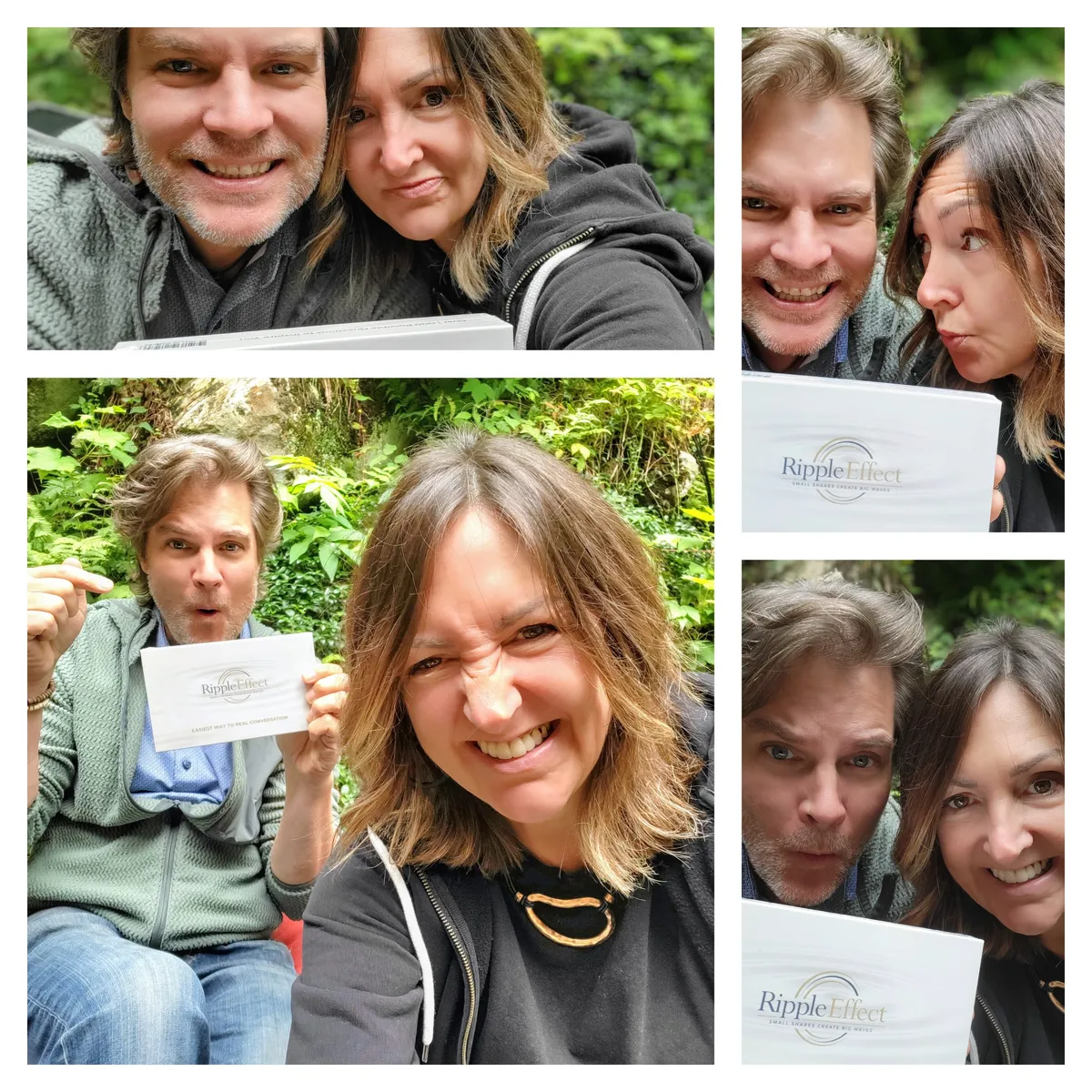
Nicole Melanson & Marc Appleby
Creators
Follow Us Here


Frequently Asked Questions
How do you play RippleEffect?
DRAW a Stone Card from the deck of 60 values. ROLL the die to find your Ripple Card. CHOOSE one of the three questions on the Ripple Card resonates most with a memory tied to your Stone Card, then share the story.
Low rolls stay light, high rolls go deeper, so with over 1,000 possible questions the game plays differently every time.
What kind of questions are in the game?
Every question is tied to a value, like Gratitude, Family, or Mastery, instead of being a random icebreaker. Each one is built to surface something true about how you see yourself, others, or the world.
Who is RippleEffect for?
Friends, families, couples, hosts, educators, and facilitators: basically anyone who wants a conversation game that goes past small talk. The die roll for depth means a first hangout and a decade long friendship can play the same deck and land in very different, equally good places.
Is RippleEffect a good dinner table question game?
Yes, it's one of the most common ways people play it. In one variation, a Stone Card is hidden under each plate and every guest shares a story tied to their card sometime during the meal, so dinner table questions become part of the meal instead of a separate activity.
What ages is it appropriate for?
13 and up. The tiered depth means teens, adults, and mixed age families can all play the same deck without anyone being pushed into a question they're not ready for.
Is there a wrong way to answer in RippleEffect?
No. Keep it light, go deep, or tell a quick story: there's no scoring and no performance involved. The point is the story, not the "right" answer.
How does RippleEffect compare to Table Topics?
Table Topics gives you a flat list of 140 questions where every question carries the same weight.
RippleEffect's flips that on its head where a player draw one of the 60 value cards, plus the die roll, plus three questions to choose from, opens up over 1,000 possible combinations of questions.
In another way, RippleEffect works backwards from most conversation games. Like Jeopardy, you get your answer first: draw your Stone Card, roll for depth, then pick which of three questions to answer. That order takes away the blank stare pressure of being asked a question cold, the way games like Table Topics can feel like a pop quiz.
What makes RippleEffect different from other conversation starter games?
Most conversation starter games hand you a fixed list of questions. RippleEffect uses a die to set the depth first, so you're never guessing how vulnerable to be. The roll decides, which takes the pressure off and keeps things moving.
The draw, roll, pick system also stacks up: 60 Stone Cards times 6 rolls times 3 questions is 1,080 possible combinations, at least five times more than other comparable conversation starter games.
It also works backwards from most conversation games. Like Jeopardy, you get your answer first: draw your Stone Card, roll for depth, then pick which of three questions to answer. That order takes away the blank stare pressure of being asked a question cold, the way games like Table Topics can feel like a pop quiz.
Copyright 2026. K&M Partners Inc.. All rights reserved.